Mangroves
Grey Mangrove
Avicennia marina
IUCN: LC
The most common species at PRPM Mengare. Its leaves give off salt crystals, and the young leaves are cooked in Gresik's sego roomo.
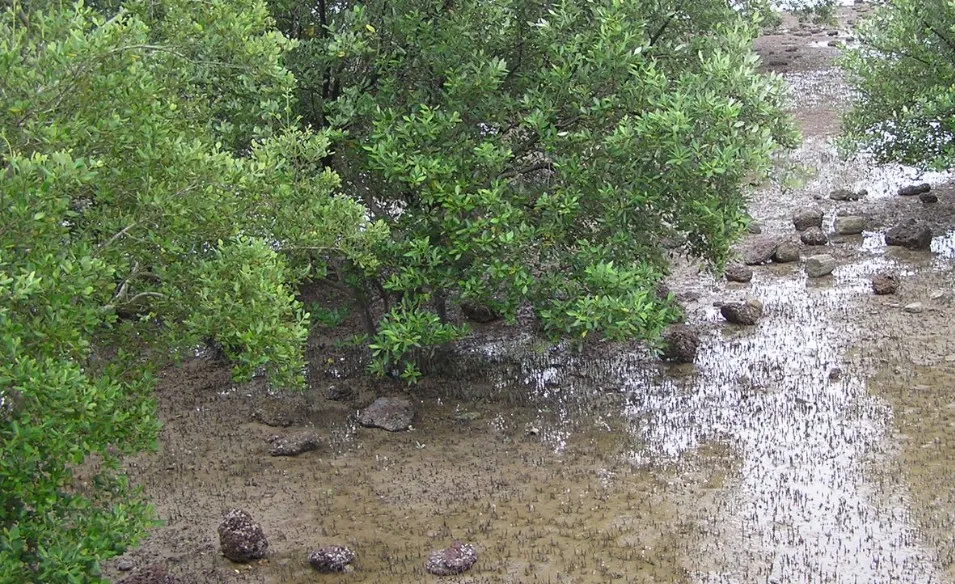
Grey Mangrove (Avicennia marina) is a mangrove of the family Avicenniaceae recorded in the biodiversity data of PRPM Mengare.
It is one of 22 species in the group “Mangroves” recorded at the site, and one of 2 species of the family Avicenniaceae.
How to recognise it
- Form
- Medium to large tree, 5–15 m tall, grey to dark brown bark, often cracked.
- Roots
- Upright pneumatophores, shorter than in A. alba, spreading densely around the tree.
- Leaves
- Opposite, oblong to elliptic, 4–10 cm; dark green above, greyish-green or silvery below.
- Flowers
- Short clusters at the twig tips; small sweet-scented pale yellow to orange flowers.
- Fruit & seed
- Ovate, slightly flattened yellowish-green fruit; the single seed often sprouts while still on the tree (cryptovivipary).
Did you know?
Grey mangrove is the most common pioneer on the coast. It tolerates high salinity, so it grows on the front line facing the sea. Salt glands on the leaves leave white crystals, so the leaves often look dusted with salt. The young leaves are cooked as urap or as the vegetable in Gresik's sego roomo.
Video from the site
Quick facts
- Scientific name
- Avicennia marina
- English name
- Grey Mangrove
- Indonesian name
- Api-api
- Family
- Avicenniaceae
- Group
- Mangroves
Conservation status
- IUCN Red List
- Least Concern
Learn more
Other species in the family Avicenniaceae and the same group
- Api-api putihAvicennia alba
- JerujuAcanthus ilicifolius
- River MangroveAegiceras corniculatum
- Teruntum bunga besarAegiceras floridum
- Tumu-tumuBruguiera cylindrica
- Lindur, tanjangBruguiera gymnorhiza